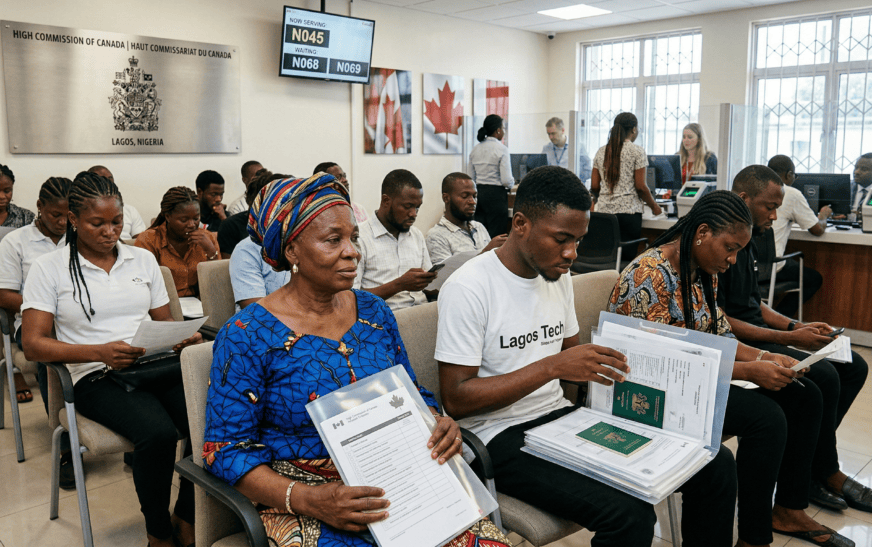
Canada consistently ranks as one of the top travel and immigration destinations for Nigerians – whether for tourism, family visits, student programmes, or business. Yet every year, thousands of Nigerian Canadian visa applications are returned, delayed, or rejected for one of the most avoidable reasons imaginable: poorly prepared or incomplete documentation.
The Canadian immigration system, managed by IRCC (Immigration, Refugees and Citizenship Canada), does not conduct in-person interviews for most visitor visa applications from Nigeria. This means your documents are not a supporting element of your application – they are your entire application. A visa officer reviewing your file will see nothing but what you submit. If your documentation is weak, inconsistent, or incomplete, there is no interview, no explanation, and no second chance in that round.
The encouraging truth is that the documents required for a Canada visa application in Nigeria are straightforward, well-defined, and entirely preparable by anyone willing to invest the time to get them right. This 2026 guide covers every document you need, what each one must show, the most common mistakes Nigerian applicants make, and how to organise everything for the strongest possible application.
Types of Canada Visas Covered in This Guide
Document requirements vary depending on which visa category you are applying for. This guide focuses primarily on the Temporary Resident Visa (TRV) — commonly called the visitor visa — which covers tourism, family visits, and short business trips. Where relevant, differences for study and work applications are noted.
| Factor | Visitor Visa | Study Permit | Work Permit |
| Primary focus | Tourism, family visit, business | Academic study in Canada | Paid employment in Canada |
| Key extra documents | Invitation letter (if visiting family) | Acceptance letter + proof of funds for tuition + living | Job offer letter (LMIA or LMIA-exempt) |
| Proof of funds | ~CAD $10,000+ for trip | Tuition + CAD $10,000+ living costs per year | Employer-confirmed income |
| Processing time | 4–12 weeks | 8–16 weeks | 4–27 weeks (varies) |
| Ties to Nigeria emphasis | Critical | Very high | High (intent to return post-permit) |
Regardless of visa type, the foundational principles of strong documentation — consistency, credibility, and completeness — apply universally.
Complete List of Canada Visa Documents for Nigerians
A BASIC REQUIRED DOCUMENTS — Mandatory for every application
Valid International Passport
Your passport must be valid for at least 6 months beyond your intended date of return to Nigeria. It must also have a minimum of two blank pages available for visa stamps. If your passport is due to expire within 12 months of your planned travel date, renew it before applying — do not attempt to submit an expiring passport.
If you have old passports that contain previous visa stamps or travel history, include them alongside your current passport. Travel history is a positive factor in Canadian visa assessments.
Passport Photographs
Two recent passport-size photographs are required. Specifications: white background, 35mm x 45mm (or 2 inches x 2 inches), taken within the last six months, no glasses, no head coverings (except for religious reasons), neutral expression, full face visible. Photos taken with mobile phones or printed in low resolution are a common reason for document rejection at the biometrics and upload stage.
Completed Application Form (IMM 5257)
All visitor visa applicants must complete Form IMM 5257 through the official IRCC online portal. Every section must be fully completed — no blanks. Common errors include leaving employment history gaps unexplained, misspelling names differently from the passport, or providing an inconsistent travel history. Any information on this form that contradicts your supporting documents triggers scrutiny.
Visa Fee Payment Receipt
The standard Canada visitor visa fee is CAD $100 per person (approximately ₦115,000 – ₦130,000 at current rates). Proof of payment must be included. Note: this fee is non-refundable, even in the case of rejection. Biometrics, if you have not given them before, cost an additional CAD $85.
Important: Always verify current fees on the official IRCC website (ircc.canada.ca) before submitting payment. Fee amounts and conversion rates change. Naira equivalents in this guide are estimated at approximately ₦1,150 – ₦1,300 per Canadian dollar.
B PROOF OF FUNDS — The most scrutinised section of any Nigerian application
Bank Statement — Last 6 Months
This is the single most important supporting document in a Canadian visa application from Nigeria. IRCC wants to see 6 months of official bank statements, stamped and signed by your bank, showing a genuine and consistent financial history.
What the statement must demonstrate:
- A consistent, maintained balance — not a single large deposit made in the final weeks before application
- Regular credit entries reflecting a legitimate income source — salary, business revenue, rental income, dividends
- Normal debit activity — utility bills, transactions, transfers. An account with only credits and no spending is viewed as suspicious
- A balance proportionate to the planned trip. For a 14-day visit to Canada, a sustained balance of ₦3,000,000 to ₦5,000,000+ (approximately CAD $2,600 to $4,400) is generally considered credible, though individual circumstances vary
The pattern of your balance matters far more than a single high figure. ₦1,500,000 maintained consistently over 6 months is more convincing than ₦6,000,000 appearing in the final week before application. Visa officers are specifically trained to identify sudden deposit patterns.
Payslips — Last 3 Months
If you are in formal employment, include your three most recent payslips. These should be employer-issued, show your gross and net salary, and be consistent with the salary figure stated in your employment letter.
Sponsorship Documentation
If a family member, friend, or employer is sponsoring your trip, you need:
- A formal sponsorship letter stating the sponsor’s name, relationship to you, commitment to covering trip costs, and specific amounts
- The sponsor’s bank statement — 6 months, stamped and signed. The sponsor’s financial profile must credibly support the claimed sponsorship
- Proof of the sponsor’s status in Canada — if your sponsor is a Canadian citizen or permanent resident, include their citizenship/PR card and proof of Canadian address
C SUPPORTING DOCUMENTS — Purpose, accommodation, and intent evidence
Employment Letter
For Nigerian applicants in formal employment, an employment confirmation letter is essential. It must be on official company letterhead, signed and stamped by HR or a senior manager, and must state your:
- Full name and job title
- Date employment commenced
- Monthly or annual salary
- Approved leave dates that cover your travel period
- Confirmation that your position will be held open and you are expected to return
The last point — confirmation of return — is particularly important. It directly addresses the visa officer’s question about whether you have reason to come back to Nigeria.
Business Registration Documents
For self-employed applicants and business owners, include your CAC certificate (Corporate Affairs Commission registration), along with business bank statements covering 6 months. Also include any contracts, invoices, or evidence of ongoing business operations that demonstrate your business requires your presence in Nigeria.
Invitation Letter
If you are visiting family or friends in Canada, an invitation letter from your host is required. It must include the host’s full name, address in Canada, contact information, relationship to you, details of where you will stay, and how long you will be visiting. Critically, it must be accompanied by proof of the host’s legal status in Canada — a copy of their passport, PR card, or citizenship certificate.
Travel Itinerary
A clear travel itinerary ties all your documents together and tells the visa officer the story of your trip. It must include:
- Return flight reservation (not a purchased ticket — a confirmed hold reservation is sufficient)
- Hotel booking or host accommodation details covering the entire stay
- A general day-by-day plan of activities — it does not need to be elaborate, but it must be consistent and coherent
The flight reservation and hotel booking dates must align perfectly with each other and with the visa duration you are requesting.
D PROOF OF TIES TO NIGERIA — Critical — often the deciding factor
Proof of ties is the category most frequently underestimated by Nigerian applicants — and it is often the reason applications with seemingly strong financials are still rejected. Canadian immigration needs to be convinced that you have compelling reasons to return to Nigeria after your visit.
Employment and Salary Evidence
Your employment letter (covered in Category C) serves double duty here. The key addition is any evidence of ongoing projects, upcoming meetings, or professional obligations in Nigeria that require your return — email printouts, project schedules, or a line in the employment letter confirming upcoming work responsibilities.
Property Documents
Ownership of property in Nigeria is one of the strongest ties an applicant can demonstrate. Include certified copies of your land certificate, deed of assignment, or property tax receipts. If you are a landlord, tenancy agreements showing ongoing rental income are particularly valuable.
Family Ties
If you have dependants in Nigeria — a spouse, children, elderly parents — include documentary evidence. Birth certificates, a marriage certificate, school enrolment records for children, or a letter from a parent’s healthcare provider can all serve as evidence that your family is in Nigeria and requires your return.
Business Ownership
Business owners should not rely solely on their CAC certificate. Include your tax clearance certificate, evidence of ongoing contracts or client relationships, and any documentation showing that your business is actively operating and dependent on your continued presence.
Insider perspective: When a visa officer sees a Nigerian applicant with documented property ownership, a confirmed salary with approved leave, children in school in Nigeria, and a consistent 6-month bank statement — the ties picture is complete and compelling. It is when one or more of these elements is missing that doubt enters the decision.
E ADDITIONAL DOCUMENTS — Situational — include where applicable
Cover Letter
A well-written cover letter is not mandatory — but it is one of the most underused tools in a Nigerian Canada visa application. A specific, personal cover letter that clearly explains your purpose of travel, your ties to Nigeria, your financial capacity, and your intent to return can positively influence a borderline decision.
What a strong cover letter includes:
- Who you are and your background (2 to 3 sentences)
- The specific purpose of your trip and what you plan to do
- How you will fund the trip
- Your ties to Nigeria and why you will return
- Any other information that adds context or clarity to your application
What to avoid: generic, template-copied cover letters are immediately recognisable and add no value. Write yours personally.
Previous Visas and Travel History
If you have previously held a UK, Schengen, UAE, or US visa — or have stamps from prior international travel — include clear copies of those pages. Prior visa approvals, especially to high-scrutiny countries, are a significant positive signal in Canadian applications.
Police Clearance Certificate
A Police Clearance Certificate (PCC) from the Nigeria Police Force is required for applicants whose visit to Canada will exceed 6 months, and may be requested for certain work permit categories. For standard short-term visitor visas, it is generally not required — but confirm this on the IRCC portal for your specific application.
Medical Examination
A medical exam is required for visitor visa applicants who plan to stay in Canada for more than 6 months, and for study and work permit applicants. It must be conducted by an IRCC-approved panel physician — you cannot use your regular clinic. A list of approved physicians in Nigeria is available on the IRCC website.
Canada Visa Document Checklist for Nigerians — 2026
Use this master table as your preparation guide. Every item marked in your category must be included:
| DOCUMENT | SPECIFICATION | COMMON MISTAKE | |
| A | Valid International Passport | Min. 6 months beyond planned travel; 2+ blank pages | Passport expires in less than 6 months |
| A | Passport Photographs | White background, 35x45mm, taken within 3 months | Wrong size, coloured background, glasses |
| A | IMM 5257 Application Form | Fully completed online via IRCC portal; no blanks | Incomplete sections; mismatched spellings |
| A | Visa Fee Payment Receipt | Proof of CAD $100 visitor visa fee payment | Applying without confirming fee is paid |
| B | Bank Statement (6 months) | Official stamp + signature; consistent balance | Only 1–3 months submitted; no bank stamp |
| B | Payslips (last 3 months) | Employer-issued, showing net/gross salary | Payslips missing or covering only 1 month |
| B | Sponsor’s Bank Statement | 6 months; accompanied by formal sponsorship letter | Sponsor’s letter present but no statement |
| B | Proof of Other Income | Investment statements, rental income, pension docs | Income claimed but no supporting evidence |
| C | Employment / HR Letter | On company letterhead; confirms role, salary, leave dates | Undated or unsigned; no leave approval |
| C | Business Registration Docs | CAC certificate + 6-month business bank statement | CAC cert only; no financial evidence |
| C | School Admission Letter | For student applicants; confirms programme and dates | Old or expired admission letter used |
| C | Invitation Letter | From host in Canada; with their status/PR/citizenship docs | Letter present but no host documentation |
| C | Flight Reservation | Return booking; dates consistent with accommodation | One-way ticket only; dates don’t match hotel |
| C | Hotel/Accommodation Booking | Confirmed reservation covering full stay duration | Dates don’t align with flights |
| D | Employment/Salary Evidence | Letter confirming employment and return date | Letter present but no salary/leave details |
| D | Property Documents | Land certificate, deed of assignment, property tax receipt | Verbal claim of property; no documentation |
| D | Family Ties Evidence | Birth certificates, marriage certificate, dependants’ docs | Family ties claimed but undocumented |
| D | Business Ownership Proof | CAC + tax clearance + ongoing contract evidence | CAC cert alone without operating evidence |
| E | Cover Letter | Personalised; explains purpose, ties, and financial capacity | Generic or internet-copied cover letter |
| E | Previous Visas / Travel History | Copies of prior visa stickers/stamps in passport | Not included despite having prior travel |
| E | Police Clearance Certificate | Required for stays over 6 months or specific categories | Obtained from wrong police authority |
| E | Medical Exam (if required) | From IRCC-approved panel physician only | Going to a non-approved clinic |
Category key: A = Basic | B = Proof of Funds | C = Supporting | D = Ties to Nigeria | E = Additional/Situational
Document Format and Submission Guidelines
Most Canada visa applications from Nigeria are submitted online through the IRCC portal. The following specifications apply:
File Formats and Size Limits
- Accepted formats: PDF (preferred for multi-page documents), JPEG/JPG for photographs
- Maximum file size: 4MB per document. If your bank statement is large, compress or split it — but do not omit pages
- Scan resolution: minimum 300 DPI for text documents; 600 DPI for passport bio-data pages and photographs
Scanning Quality
- Scan documents flat — no bent edges, shadows, or fingers in the frame
- Ensure all text is fully legible, including bank stamp signatures and company letterhead details
- Colour scans are preferred for passports and photographs; black and white is acceptable for text documents
File Naming
- Use clear, descriptive file names: BankStatement_Jan–Jun2026.pdf, EmploymentLetter_CompanyName.pdf, PassportBioPage.pdf
- Avoid generic names like Document1.pdf or Scan001.jpg — these create confusion when multiple documents are reviewed
Physical vs Online Submission
As of 2026, virtually all Canadian visitor visa applications from Nigeria are submitted online. Physical document submission is only required in exceptional circumstances as directed by IRCC. If biometrics are needed and you have not previously provided them, you will be directed to a Visa Application Centre (VAC) — the primary one for Nigeria is operated by TLS Contact in Lagos and Abuja.
Common Document Mistakes Nigerian Applicants Make
- Submitting fake or fabricated documents. The most damaging mistake. IRCC has verification procedures and relationships with Nigerian institutions. A fabricated bank statement or employment letter can result in a multi-year inadmissibility ruling. No application is worth this risk.
- Only providing 1 to 3 months of bank statements instead of the required 6. This is one of the most consistent technical reasons Nigerian applications are returned without processing.
- Making a large cash deposit immediately before applying. This pattern is widely recognised and raises serious credibility concerns about the authenticity of the financial picture.
- Not including the sponsor’s full documentation. A sponsorship letter without the sponsor’s bank statement and proof of Canadian status is almost always insufficient.
- Submitting a bank statement without an official stamp and signature. Online printouts or self-generated PDF statements are not accepted — they must carry the bank’s official stamp.
- Inconsistency between documents. Name spellings, dates, salary figures — any mismatch between your application form, employment letter, and bank statement invites rejection.
- Not including previous visa copies despite having a travel history. These are significant positive evidence and should always be included.
How to Prepare Your Canada Visa Documents Like a Pro
Professional document preparation is not just about having the right papers — it is about presenting them in a way that makes the visa officer’s review as clear and effortless as possible. A well-organised application communicates competence and attention to detail. A disorganised one raises questions.
Logical Document Order
Arrange your documents in the same sequence as the official IRCC checklist — basic documents first, then financial, then supporting, then ties evidence, then additional. Upload them in this order. Label each document clearly when uploading to the portal.
Consistency Across Every Document
Before uploading anything, cross-check the following across every document in your application:
- Your full name — spelled identically on every document, matching your passport exactly
- Dates — travel dates align across your flight reservation, hotel booking, and visa application form
- Financial figures — if you mention a salary in your cover letter, it must match your payslip and your employment letter exactly
- Purpose of travel — the reason stated in your cover letter, on your application form, and supported by your itinerary must all tell the same story
The Self-Review Test
Once you have assembled all documents, conduct a final self-review: read through everything as if you were a visa officer seeing this application for the first time. Ask yourself — does this application tell a coherent, consistent, and credible story? If anything is unclear, unexplained, or contradictory, address it before submitting.
Pro tip: Have someone else — ideally a knowledgeable person or licensed travel agent — review your complete document pack before submission. A fresh set of eyes catches inconsistencies that you may have stopped noticing after reviewing your own documents repeatedly.
Expert Tips to Strengthen Your Canada Visa Application
- Start building your bank statement 4 to 6 months before you plan to apply. A strong financial profile cannot be created overnight. Begin now, even if your travel date is months away.
- Be honest and consistent throughout your application. Every document, every statement, every figure must reflect your genuine situation. IRCC systems are designed to identify inconsistencies — honesty is always the stronger strategy.
- Write a personal, specific cover letter. Generic letters add no value. A well-written personal letter that explains your ties, your purpose, and your finances can meaningfully influence a borderline decision.
- Apply at least 6 to 8 weeks before your planned travel date. Standard Canadian visitor visa processing times range from 4 to 12 weeks from Nigeria. Never apply at the last minute.
- Ensure all scans are clear, complete, and properly named. Illegible or incomplete document scans are a common reason applications are returned for resubmission.
- Include every prior visa and travel stamp in your passport. Travel history is one of the most positive signals in a Canadian application — do not leave any out.
- Never rush your application. Incomplete or poorly prepared applications that are rejected leave a record. Take the time to do it properly the first time.
- Work with a reputable, licensed travel agency for your first application or after a previous rejection. Professional document review before submission is a practical investment that significantly improves outcomes.
Nigeria-Specific Insights for Canada Visa Applicants
Common Document Patterns Among Nigerian Applicants
The document issues that most consistently affect Nigerian Canada visa applications are: insufficient bank statement duration (submitting 1 to 3 months instead of 6), staged deposits in the final weeks before application, missing ties-to-Nigeria evidence, and employment letters that confirm a position but do not include salary or leave approval details.
Being aware of these patterns — and deliberately addressing each one — significantly distinguishes a well-prepared Nigerian application from an average one.
The Role of Licensed Travel Agents
A licensed and experienced travel agent adds value at two specific stages of a Canadian visa application: document preparation and quality review. A good agent will identify gaps in your file, flag inconsistencies before submission, and advise on how to present your financial and personal profile most credibly. What a good agent will not do is promise approval — no legitimate agent makes that guarantee.
Be cautious of agents who offer to fabricate, inflate, or create documents on your behalf. These offers represent serious legal risk to you — not to the agent.
Lagos vs Abuja Application Experience
Canadian visa applications from Nigeria are submitted online via the IRCC portal — the process is identical regardless of whether you are in Lagos, Abuja, Port Harcourt, or any other city. Biometric appointments, if required, are conducted at TLS Contact Visa Application Centres in Lagos (Victoria Island) and Abuja (Wuse 2). Both centres offer the same services; appointment availability may vary seasonally, so book early.
Prepare Right, Apply with Confidence
The documents required for a Canada visa application in Nigeria are clearly defined, consistently structured, and entirely manageable for a well-prepared applicant. The difference between an approved application and a rejected one almost always comes down to three things: the quality of the financial evidence, the strength of the ties-to-Nigeria documentation, and the consistency of every piece of information across the complete document pack.
Do not rush. Do not fabricate. Do not underestimate any single category of documents, especially the bank statement and the ties evidence. Use this guide as your working checklist, cross-reference every item before submitting, and give yourself enough time to address any gaps before your planned travel date.
Canada is an achievable destination for Nigerian applicants who prepare properly. This guide gives you the framework. The preparation is yours to do — and it is absolutely worth doing right.
Need Help With Your Canada Visa Application?
Tbils Travels provides expert Canada visa guidance for Nigerian applicants — including complete document review, bank statement assessment, cover letter preparation, and submission support. We have helped hundreds of Nigerian travellers successfully prepare their Canada visa applications from first enquiry to final approval.
Visit www.tbils.com or contact us today to get started.