
You sit at your computer on a Tuesday evening, watching how quickly flight prices fluctuate in Nigeria while looking at international airline tickets for an upcoming family trip. You find a reasonable deal, but you decide to sleep on it to confirm your leave dates with your manager.
When you log back in on Wednesday morning, the price for the exact same seat on the exact same flight has jumped by three hundred thousand Naira.
This frustrating experience is incredibly common. It is a harsh reality that flight prices fluctuate in Nigeria faster than most travelers can keep up with. One day you are looking at competitive international airfare deals, and the next day those options seem entirely out of reach.
The volatility of the Nigerian aviation market leaves many travelers wondering if there is any logic behind the madness. It often feels like airline ticket pricing is completely random, designed purely to catch buyers off guard.
However, flight pricing is governed by a complex blend of global economic factors, localized financial realities, and advanced digital algorithms. Understanding these mechanisms can transform how you plan your journeys and save you significant amounts of money.
Why Do Flight Prices Fluctuate in Nigeria?
Flight prices fluctuate in Nigeria primarily due to foreign exchange rate volatility, shifting seasonal demand, dynamic airline pricing algorithms, and fluctuating aviation fuel costs. Because international airline tickets are priced globally in US Dollars, any depreciation of the Nigerian Naira instantly inflates local ticket prices for Nigerian travelers.
1. Primary Causes Why Flight Prices Fluctuate in Nigeria
The Nigerian aviation market is shaped by a unique intersection of domestic economic policies and global industry standards. The final cost of airfare reflects a combination of base fares, fuel surcharges, regulatory fees, and airport taxes. Because these components are subject to frequent adjustments by both local authorities and global aviation bodies, price stability is rare.
Furthermore, international carriers must account for localized operational expenses, such as ground handling, catering logistics, and infrastructure maintenance. These costs, combined with corporate revenue targets, are factored into the dynamic pricing models that dictate daily fare changes. The following key drivers primarily influence these fluctuations:
- Dynamic algorithms that recalculate fares in real-time based on demand
- Currency devaluation of the Naira against major foreign currencies
- High seasonal demand during major holiday and vacation periods
- Limited seat inventory on high-traffic international routes
- Escalating aviation fuel costs and associated surcharges
- Market competition and last-minute booking behaviors
2. How Airline Pricing Systems Work When Flight Prices Fluctuate in Nigeria
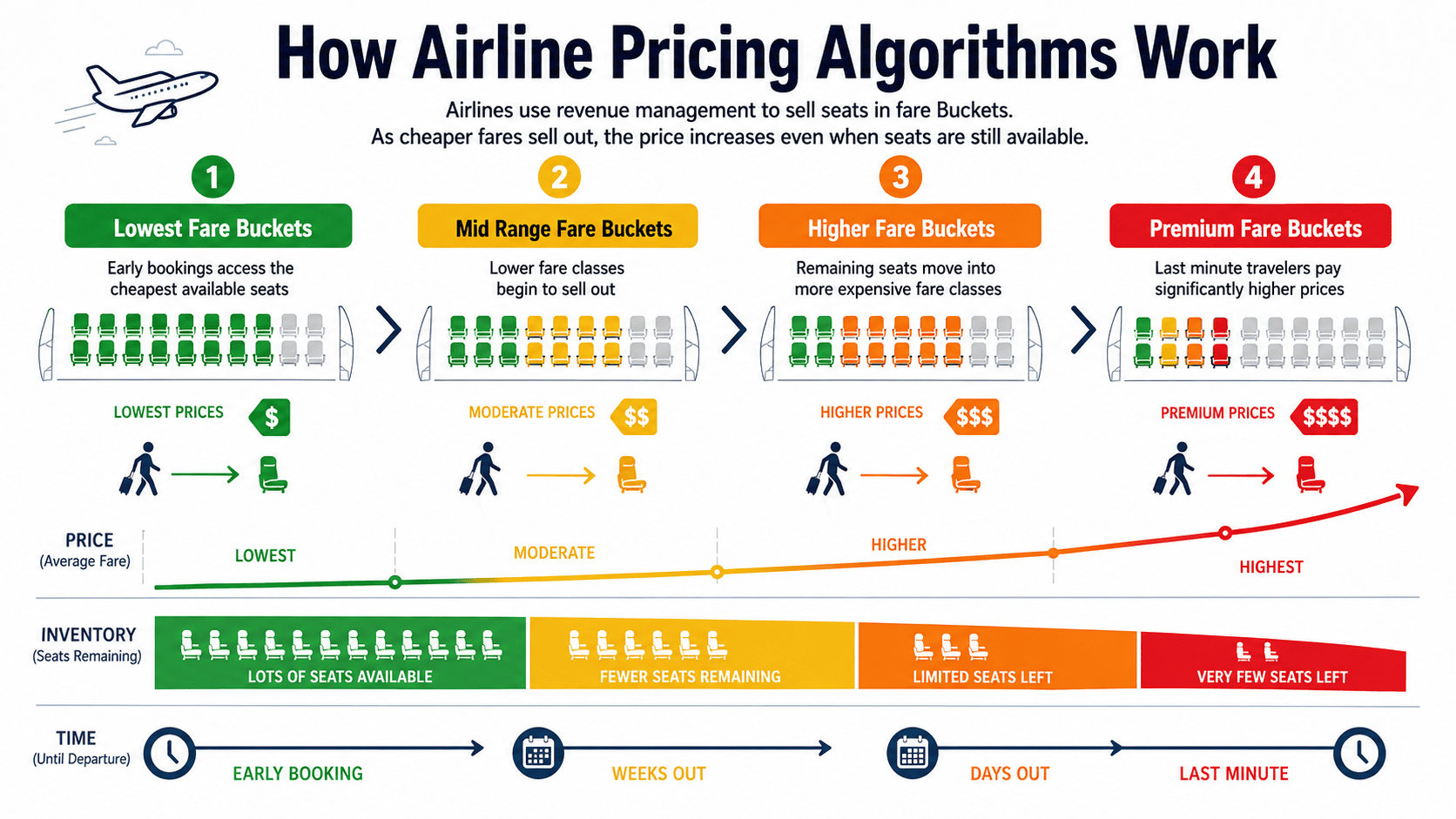
Airlines do not charge a single fixed price for seats. Instead, they use a sophisticated process called yield management, or revenue management. Real-time automated systems power this entire process.
These systems divide aircraft capacity into distinct price categories known as fare buckets. When an airline first loads a flight into the system, they allocate a small percentage of seats to the cheapest buckets. As travelers buy these cheap seats, the system automatically opens the next, more expensive tier. This ensures that the remaining inventory captures higher revenue for the airline.
These pricing algorithms constantly monitor demand signals and consumer behavior. For example, if the system detects a surge in searches for a specific route like Lagos to London, it may raise prices within seconds.
Conversely, airlines apply demand forecasting to predict occupancy. If a flight is tracking to be under-filled, the system will soften prices. This stimulates bookings and fills capacity before departure.
This dynamic nature explains why a fare can change completely between morning and afternoon. Every time you search for a route without booking, you are feeding data into these models. The more frequent the searches, the more confident the airline becomes that demand is strong. As a result, the system adjusts prices upward.
3. Impact of Supply and Demand on Airfare Fluctuations
The economic principles of supply and demand dictate a significant portion of international airfare. Since every aircraft has a finite number of seats, prices inevitably rise when traveler interest outpaces available capacity.
In Nigeria, this imbalance is particularly acute. We have a massive traveling population but a limited number of international carriers operating premium routes. Therefore, available seat inventory can vanish rapidly during high-traffic periods.
Conversely, when demand dips, airlines introduce promotional deals to fill cabins. An empty seat represents unrecoverable revenue. For this reason, pricing software may drop fares to a baseline minimum, creating brief windows for flexible buyers to secure cheap tickets.
This dynamic is especially evident on major routes:
Lagos to London: Travelers compete for limited seats across several major carriers. During peak periods, airlines remain confident that these seats will fill regardless of the price, leading to elevated fares.
Lagos to Toronto: This route has seen a massive surge in demand driven by migration trends. Because supply cannot scale as quickly as this rising demand, fares on Canada-bound flights often remain high throughout the year.
Nigeria to USA Flights: Routes to major hubs like Houston, New York, and Atlanta maintain steady demand from the diaspora, students, and business travelers. This results in consistently higher pricing compared to less-trafficked destinations.
Ultimately, planning ahead for low-demand windows is the most effective way to find competitive fares. Look for mid-week departures in January, September, or October when seat availability is at its highest.
4. How Exchange Rates Affect International Flight Tickets in Nigeria
Perhaps no factor influences the price of international flight tickets in Nigeria as dramatically as the foreign exchange rate. International aviation operates globally on the US Dollar. Everything from aircraft leasing and maintenance to international overflight permits must be settled in foreign currencies.
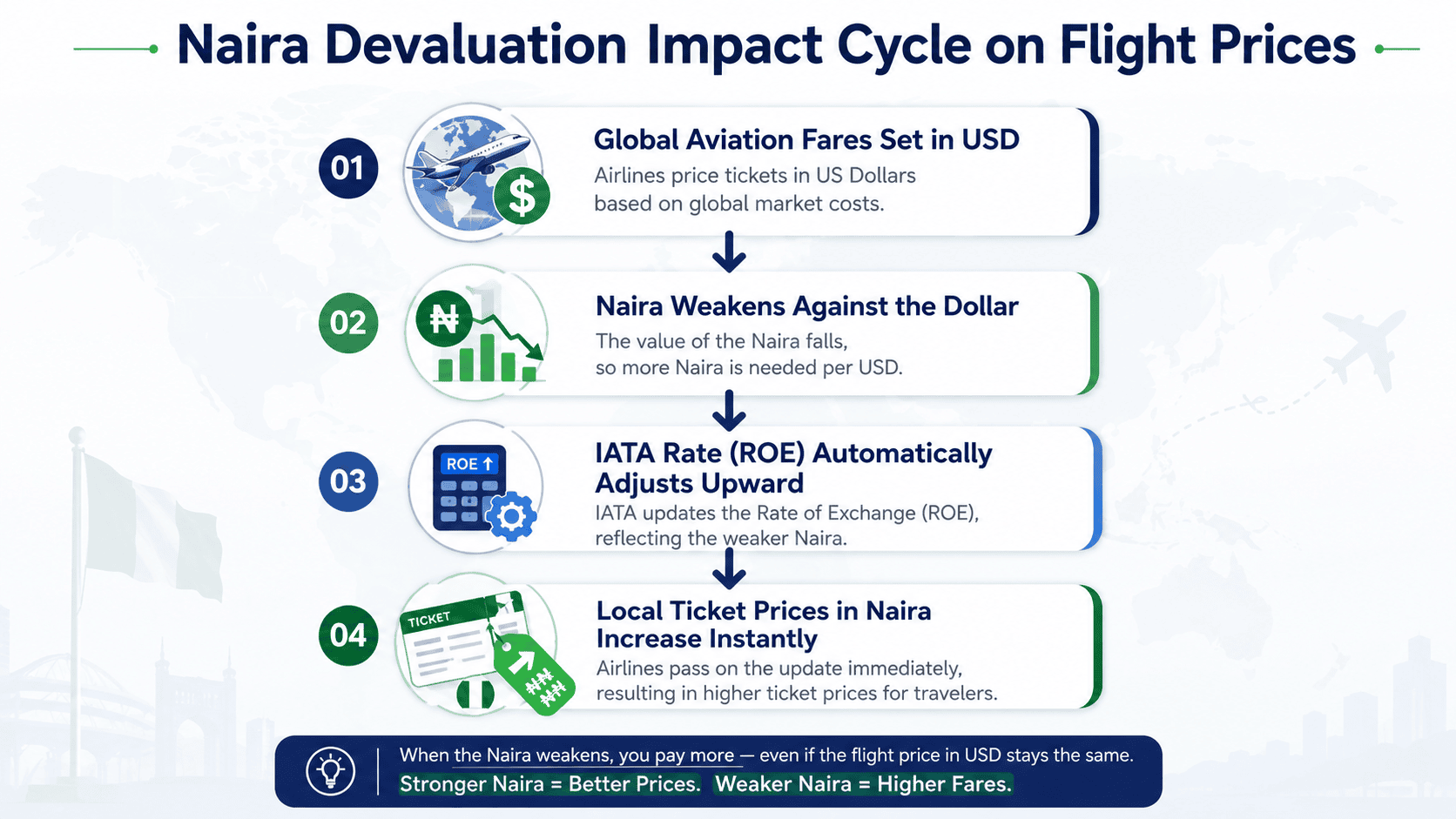
The International Air Transport Association (IATA) utilizes an automated system to set the Rate of Exchange (ROE) applied to ticket sales in Nigeria. This rate updates regularly to reflect the official value of the Naira against the Dollar. When the Naira weakens, the IATA rate adjusts upward, meaning that even if an airline does not change its base fare in Dollars, the cost in Naira rises instantly.
This currency dynamic explains why a flight that cost one million Naira last month can suddenly cost much more today without the airline changing its core pricing structure. Travelers must also account for the challenges airlines face when trying to repatriate their ticket sales revenue out of the country. When funds become trapped due to foreign exchange scarcity, airlines often protect their margins by restricting access to their lowest fare buckets for tickets purchased locally in Naira.
This is the factor that makes international flight costs uniquely painful for Nigerian travelers.
For Nigerian travelers, you are effectively watching two markets: seat inventory and currency valuation. This makes working with an experienced agency like TBILS valuable. A consultant can identify booking windows where both factors align. You can also find detailed cost breakdowns in the TBILS guide on the cost of travelling from Nigeria to the UK in 2026.
5. Peak Travel Seasons When Flight Prices Fluctuate in Nigeria
The time of year you choose to travel plays a massive role in the final price of your ticket. Nigerian travel patterns are highly seasonal, dictated by cultural celebrations, academic calendars, and global holidays. During these predictable peak periods, finding cheap airline tickets becomes a major challenge.
Christmas Travel
December is consistently the most expensive month to fly internationally from Nigeria. Demand builds rapidly from mid-November as Nigerians abroad return home for the holidays and Nigerians at home travel to visit family overseas. By early December, the cheapest fare classes are typically exhausted. Travelers who wait until November or December to book a December flight almost always pay the highest available rates.
Summer Holidays
July and August represent the second major demand peak of the year. Families with school-age children, professionals taking annual leave, and Nigerians visiting relatives in Europe and North America all converge on this window. Fares on the Lagos to London route and Nigeria to Canada flights rise noticeably from late June and remain elevated through August.
Easter Period
The Easter travel surge is shorter than Christmas but still significant, particularly on UK and European routes. With Easter falling anywhere from late March to late April depending on the year, travelers who book two to three months ahead consistently pay less than those who book close to the holiday.
School Breaks
School term breaks and resumption periods have become an increasingly relevant pricing factor as the number of Nigerians studying abroad in the UK, Canada, and the USA has grown. Students relocating or returning to university create predictable demand spikes on specific routes during very predictable windows each year.
Japa Travel Seasons
The sustained movement of Nigerians relocating abroad has created its own pricing dynamic. When batches of UK, Canadian, or US visas are approved and holders begin booking travel, demand on those routes spikes sharply within a compressed window. Seat availability falls quickly, and prices follow. Travelers who book before visa approval comes through are often in a significantly better position than those who wait.
6. How Aviation Fuel Costs Cause Airfare to Fluctuate
Aviation fuel, known technically as Jet A-1, is the single largest operational expense for any airline, typically accounting for 20% to 30% of total running costs. Because Nigeria relies heavily on imported refined petroleum products, local supplies of aviation fuel are highly vulnerable to global oil market shocks and domestic supply chain disruptions.
When global crude oil prices rise or local fuel scarcity hits Nigerian airports, marketers raise the price per liter of Jet A-1. Because airlines cannot absorb these massive spikes without impacting their bottom line, they pass a portion of these expenses to passengers through a pricing mechanism known as a fuel surcharge.
These surcharges are added directly to the base fare of your ticket. On long-haul routes popular with Nigerian travelers—such as Lagos to London or Lagos to Toronto—fuel surcharges can represent a substantial portion of the total cost listed on your ticket. If you notice a sudden, simultaneous price jump across multiple airlines, a spike in fuel costs is almost always the underlying culprit.
Interestingly, when global oil prices fall, ticket prices do not drop at the same speed. Airline pricing adjustments routinely lag behind cost reductions. While a sudden cost increase reflects in your fare almost instantly, a dip in global oil prices can take weeks or even months to translate into cheaper international airline tickets.
7. Why Last-Minute Bookings Impact Ticket Prices
A persistent misconception among casual travelers is that airlines drop their prices at the last minute to fill empty seats. While this markdown strategy occasionally happens with cruise lines or certain low-cost domestic carriers, commercial airlines operating major long-haul routes do exactly the opposite. On highly competitive corridors from Nigeria, such as flights from Lagos to London, Toronto, or New York, waiting until the last minute is a gamble that almost always results in paying premium fares.
Because flight prices fluctuate in Nigeria so frequently, waiting until the last minute is rarely a sound strategy.
Airlines understand that passengers booking within days or weeks of departure are rarely leisure travelers planning a casual vacation. Instead, they are typically business professionals responding to urgent corporate needs, families handling sudden emergencies, or individuals executing time-sensitive relocations. Because these travelers have a strict necessity to fly, they have minimal flexibility and are far less price-sensitive.
Knowing this, an airline’s revenue management software automatically locks down discounted fare classes as the departure date approaches. As the available seat inventory shrinks, the system leaves only the highest-tier, fully flexible economy and premium tickets open.
When you attempt to secure a flight to Nigeria from UK origins or vice versa at the eleventh hour, you are competing for the absolute last remaining inventory. At this stage, the airline holds all the pricing leverage, making last-minute bargains the rare exception rather than the rule. Counting on a sudden price drop to save you money is a strategy that ultimately costs far more than it delivers.
8. Best Time to Book Before Flight Prices Fluctuate in Nigeria
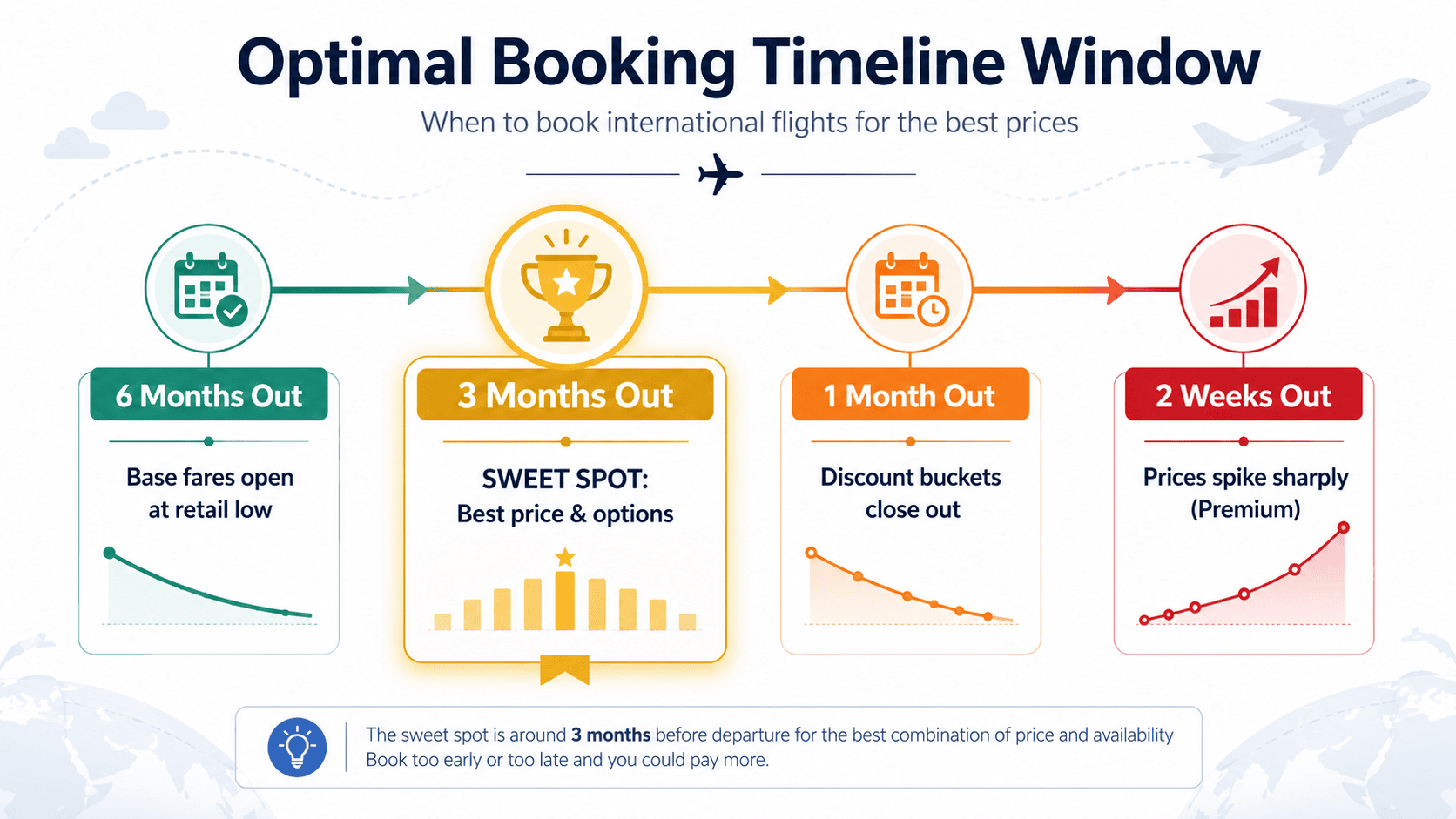
Securing affordable tickets requires strategy, and timing is your most powerful tool. As a general rule for international travel, airlines open their initial fare buckets months in advance before heavy demand triggers automated price increases
Strategic Windows Before Prices Shift
While the ideal booking sweet spot is generally three to six months out, specific target windows vary depending on your destination and the time of year:
- Flights to the UK: For standard travel periods, book 6 to 10 weeks ahead. If you are planning a December trip, aim to lock in fares by September or early October, while summer travel requires looking around March and April. For deeper, route-specific insights, check our Lagos to London Flight Guide and our detailed breakdown on How to Find Cheap Flight Tickets from Lagos to London (2026 Complete Guide).
- Flights to Canada: Demand on Nigeria-to-Canada routes remains consistently high, and prices rarely drop close to departure. Secure your ticket 8 to 12 weeks in advance for standard periods, and 3 to 4 months ahead if you are traveling for the summer or December rushes.
- Flights to the USA: Plan to book 8 to 12 weeks in advance for regular travel periods. Major holidays including Thanksgiving, Christmas, and the 4th of July require locking in your tickets 3 to 4 months out to avoid highly inflated premium tiers.
- Flights to Europe: A window of 6 to 10 weeks in advance handles most standard European travel well. However, peak seasons like Christmas and summer demand earlier action, ideally 3 months or more before your departure date.
Beyond how many weeks in advance you book, the specific day of the week you purchase your ticket can also yield noticeable savings. Historical booking trends indicate that mid-week days, particularly Tuesdays and Wednesdays, generally offer lower rates because corporate booking volumes drop off and airlines often release updated tariff schedules.
For a complete blueprint on navigating these seasonal trends and automated pricing cycles, look at our comprehensive resource: Best Time to Book Cheap Flights from Nigeria (2026 Complete Guide) to ensure you never overpay for your seats.
9. Common Booking Mistakes When Flight Prices Fluctuate

Even experienced travelers make errors that cost them money. These are the ones that come up most often.
- Waiting too long to book. This is the most common and most expensive mistake on international routes from Nigeria. Prices on long-haul routes trend upward as departure approaches, not downward. Waiting for a better price almost always means paying a higher one.
- Checking only one platform or airline. Booking the first result you see on one website, without comparing across airlines and platforms, leaves money on the table consistently. A few minutes of comparison can save significant amounts.
- Focusing only on the base fare. A low headline price that comes with heavy baggage fees, multiple long layovers, or a poor seat allocation may not be the best deal in practice. Evaluate total travel time, total cost including fees, and stopover duration together.
- Booking during peak search times. Fare prices on some platforms can show slight differences based on search volume. Many travel experts recommend searching for flights mid-week rather than on weekends, when search activity is typically higher.
- Ignoring exchange rate timing. A period when the naira is relatively stable against the dollar is effectively a pricing window, even if the airline’s dollar price has not changed. Booking during these periods saves money in the same way a fare promotion does.
- Using unverified third-party booking platforms. The lowest price on an obscure platform is not always a saving. Ticketing problems, refund difficulties, and airline policy complications are far easier to resolve when you have a reputable agency or well-established platform behind your booking.
For a more detailed breakdown of what to avoid when booking, read our guides on how to book cheap international flights from Nigeria.
10. Practical Ways to Save Money When Flight Prices Fluctuate
While you cannot control global exchange rates or fuel costs, you can adapt your booking habits to outsmart automated pricing systems. Implementing these practical adjustments will save you significant amounts of money over time.
- Set Digital Price Alerts: Do not waste hours manually refreshing airline websites every day. Instead, use online travel platforms like Google Flights, Skyscanner, or Kayak to set up automatic price alerts for your desired routes. These systems monitor fare adjustments constantly and send an email notification the moment a price drops into your target range, ensuring you never miss a budget-friendly booking window.
- Keep Your Travel Dates Flexible: A shift of just 24 to 48 hours can result in massive savings. If your schedule allows any flexibility, use the flexible calendar view options when researching your travel options. Flying on a Tuesday, Wednesday, or Thursday instead of a weekend evening allows you to bypass the heavy weekend travel surcharges that airlines routinely apply, particularly on competitive transatlantic routes.
- Book Well in Advance: Procrastination is the ultimate enemy of cheap travel. Securing your international travel tickets long before your departure date protects you from the mandatory fare bucket upgrades that occur as an aircraft fills up. As a rule of thumb, aim to book two to three months ahead for standard travel periods, and three to four months in advance if you are traveling during peak holiday seasons.
- Compare Alternative Routes and Hubs: Direct flights offer unmatched convenience, but they come with a steep premium. If you want to find the cheapest international airlines, look at options that involve a single layover in regional hubs like Kigali, Casablanca, or Istanbul. Additionally, compare alternative arrival airports. If you are heading to Canada, check fares into Montreal alongside Toronto Pearson; for the USA, look at multiple entry points like New York, Houston, and Atlanta to see where the long-haul portion of your trip is most affordable.
Ready to Book Your Next International Flight?
Navigating the constantly changing world of international airfare does not have to be an overwhelming or stressful experience. While algorithms and unpredictable economic shifts drive ticket prices, working with a dedicated, professional agency like TBILS gives you the specialized knowledge needed to bypass these complexities.
We provide exclusive access to private consolidator fares, real-time booking adjustments, and expert advisory support that standard retail websites simply cannot match. Whether you need end-to-end relocation advisory services, family holiday planning, or streamlined corporate travel management, our team delivers complete support from start to finish.
By understanding the core reasons why flight prices fluctuate in Nigeria, you can better time your purchases and save significantly on your international travel.
Stop guessing when the best time to buy will be. Let our experienced travel experts secure the ideal deals for your upcoming journey to the UK, Canada, the USA, or any global destination.